Search engine
Showing posts with label Islam. Show all posts

Tuesday, December 14, 2010

Islamic party quits Pakistan government over minister

0

ISLAMABAD  – An Islamic party said on Tuesday it was pulling out of Pakistan's ruling coalition after the dismissal of one of its members as a minister, but the government was not expected to fall.

"It is impossible to stay in the coalition. We are saying goodbye to the government" Jamiat-e-Ulema-e-Islam (JUI) leader Fazal-ur-Rehman told reporters after a party meeting. His party's name translates to "Party of Islamic Clerics."

The decision was taken after Prime Minister Yusuf Raza Gilani sacked two ministers including one from JUI, Muhammad Azam Khan Swati, the minister for science and technology, for publicly trading accusations of corruption.

While the government is highly unlikely to collapse -- the JUI is a small coalition partner -- the move will raise fresh questions over U.S. ally Pakistan's political stability.

The governing coalition, which faces an array of challenges including homegrown Taliban militants and a fragile economy, now holds 181 out of 342 seats in parliament, nine more than the 172 needed to maintain its majority.

Rehman said two other JUI members of the cabinet -- the ministers of tourism and housing -- from his party would also resign.

Gilani's government, struggling to implement reforms needed to secure the sixth tranche of an $11 billion International Monetary Fund loan keeping the economy afloat, could now be distracted by political turbulence.

The IMF's program, agreed in November 2008, is increasingly critical for Pakistan as it grapples with a widening fiscal deficit and summer flood losses of $10 billion.

Pakistan plans to seek an extension of the loan program to win more time to implement the reforms needed to secure the next tranche, a Finance Ministry official has said.

The main issue is Pakistan's slow implementation of a reformed general sales tax (RGST), a key condition for the possible release of the sixth tranche.

"With JUI quitting the coalition, the approval for RGST will become even more challenging," said Asif Qureshi, director at Invisor Securities Ltd.

Rehman said his party would vote against the RGST.

Pakistan is under intense international pressure to broaden its tax-to-GDP ratio, currently around 10 percent, one of the lowest in the world.

Pakistan's most popular politician, Nawaz Sharif, has said his party will oppose any imposition of the RGST.

"The government will find it difficult to sustain itself unless it maneuvers to find new partner," said political analyst Hasan Askari Rizvi.

Monday, December 13, 2010

Bashir Faces Death Penalty With New Charges: Trial Set for Early Next Year

0

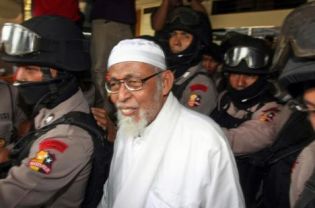
The case of firebrand Islamic cleric Abu Bakar Bashir, charged with multiple counts of terrorism punishable by death, was on Monday handed over to prosecutors in preparation for his trial, which is expected to start early next year.

The 72-year-old is accused of leading and financing the paramilitary training activities of a group of suspected militants in Aceh who were the target of a series of raids early this year.

“He’s been charged under at least five articles in the antiterror law,” said Yusuf, the South Jakarta chief prosecutor.

“The most serious is mobilizing people for acts of terrorism, which carries the death sentence.”

Bashir was brought to the district prosecutor’s office under tight guard, escorted by two armored vehicles and dozens of armed officers from the police counterterrorism unit.

Police handed over dozens of firearms and a stack of documents as evidence against the cleric.

“We’ve verified the evidence, including handguns, rifles, ammunition for various firearms such as AK-47s and M-16s, recorded phone conversations, money and copies of bank transfers,” Yusuf said.

“We’ve also interrogated the suspect — he was fit and able to answer questions. He signed a statement protesting his interrogation and arrest.”

Yusuf said 32 prosecutors would have 60 days to prepare the case for trial, during which time Bashir would remain in police custody.

Bashir’s lawyer, Achmad Michdan, said the cleric had denied having anything to do with the evidence aside from a cellphone that was seized by police during his arrest on Aug. 9.

Another of his lawyers, Luthfie Hakim, said the terrorism charges against Bashir were being laid at the behest of foreign governments and pointed out that his client had twice been tried for terrorism in the past, but was acquitted on both occasions.

Bashir himself protested his innocence and said the case against him was part of a wider campaign against Islam.

“Islamic teachings are being terrorized,” he said before being returned to the National Police’s detention center.

National Police spokesman Sr. Comr. Boy Rafly Amar said police would hold a press conference in Solo, Central Java, on Tuesday to release more details about Friday’s arrest of Abu Tholut, who is believed to have been the trainer for the Aceh militant camp and had been the country’s most wanted terrorist suspect.

“We’ll give a full explanation on Tuesday, including about the arrest of Sukirno in Jombang, East Java, who allegedly provided shelter for Abu Tholut,” the spokesman said.

Bashir acknowledged Tholut had once worked at the cleric’s Jamaah Anshorut Tauhid, a hard-line organization that calls for Shariah law to be implemented across the country, but said Tholut had left due to ideological differences.

“Tholut is a holy warrior,” Bashir said on Monday.

Bashir was previously tried on charges related to the 2002 Bali bombings and the 2003 bombing of the JW Marriott Hotel in Jakarta.

He was sentenced to two and a half years for his role in a “sinister conspiracy” in the Bali bombings but cleared of charges related to the hotel attack. However, in 2006, the Supreme Court overturned his terror conviction.

The new charges against him stem from claims made by three of his alleged followers that Bashir persuaded them to fund the Aceh militant camp.

All three are accused of raising and providing at least Rp 350 million for the camp after Bashir allegedly told them, on separate occasions, “We are launching a program of major jihadi activities. If you have extra money, you can donate to us and the biggest returns will come from God.”

The Aceh camp was widely believed to be planning Mumbai-type attacks on key targets, including the president and state guests during Independence Day ceremonies at the State Palace in August.

sourch: thejakartaglobe.com


Indonesian cleric could face death penalty

0

An Islamic cleric accused of helping fund and establish a terror cell and military training camp could face the death penalty, according to the formal investigation submitted to prosecutors Monday.

Abu Bakar Bashir was detained August 9, when police said he played a key role in the establishment of a militant training camp in Indonesia's Aceh region.

"All terrorism charges carry the death penalty," said Indonesian police spokesman Boy Rafli. "He is suspected with illegal possession of weapons, sheltering wanted terrorist suspects and concealing information about known terrorists."

Along with their investigation, police also submitted to prosecutors dozens of pieces of evidence, including assault rifles and ammunition.

Muhammad Yusuf, the head of the South Jakarta Prosecutor's Office, promised a swift trial for Bashir.

"The harshest allegation is inciting others to commit crimes of terrorism," he was quoted by the Indonesian news service Antara as saying. "We will process the case immediately. We want to try him quickly."

Bashir "rejects and denies all the charges against him," lawyer Achmad Michdan said in August.

The Muslim cleric has refused to answer questions in his interrogations. Bashir believes his arrest was a result of pressure by the west, particularly the United States, Michdan said.

Bashir -- a religious leader known for his anti-Western rhetoric -- has been arrested twice previously for his activities in connection with militant groups.

Edward Aritonang, a national police spokesman, said in August that authorities had strong evidence Bashir played a role in establishing a terror cell and a militant training camp in Aceh province.

Police raided that camp in February and arrested dozens of militants who allegedly were planning terror attacks in Indonesia similar to those that took place in Mumbai, India, in 2008.

Officials said Bashir knew about that camp, helped fund it and appointed religious teachers to provide the militants with spiritual guidance. Bashir allegedly appointed an extremist fugitive known as Dulmatin as the field commander.

Dulmatin was killed in another police raid shortly afterward.

In May, several members of a hardline organization Bashir founded -- the Jama'ah Ansharut Tauhid, or JAT -- were also arrested and charged with raising funds for the training camp.

Bashir was first arrested after the Bali bombings that killed more than 200 people in 2002. At the time, he was the spiritual leader of Jemaah Islamiyah, whose stated goal is to create an Islamic state comprising Malaysia, Singapore, Indonesia and the southern Philippines.

He was charged with terrorism and immigration violations and served 18 months in jail.

Two years later, before his expected release in 2004, Bashir was arrested again on charges of helping incite the August 2003 bombing of the Marriott hotel in Jakarta.

He served two-and-a-half years in jail and was released in June 2006. In 2008, Bashir established Jama'ah Ansharut Tauhid.


Vigilante jihad: Inside Indonesia’s Islamic Defenders Front

0

It is forever dark in the core of Jembatan Besi, one of Jakarta’s most crowded slums. Even at high noon, only a narrow band of sunlight glows above a five-story canyon formed by closely built cement dwellings.

To slip into the narrowest walkways — crevices, really — locals must twist their bodies and shimmy sideways. Fluorescent lamps, slung from extension cords, light their path.

Still, according to the neighborhood holy man, it used to be worse. The crowding and poverty was once compounded by wickedness.

After the three-decade reign of strongman Gen. Suharto came to an end 12 years ago, society went wild with freedom, said Tubagus Muhammed Siddiq, 53, a white-robed Islamic scholar and Jembatan Besi native.
A member of the Islamic Defender's Front,
called in Indonesia Front Pembela Islam,
or FPI, attends an anti-Israel protest
outside the U.S. Embassy in
Jakarta on Dec. 31, 2008.

Throughout the island of Java, he said, prostitution, gambling and boozing crept from the shadows and into the streets. Inept police did nothing, he said.

“My neighborhood was one of the worst. Three straight blocks of gambling and drinking.” Siddiq said. “We had no choice. We were forced to jihad.”

With other fundamentalists around the city, Siddiq co-founded a vigilante network called the “Islamic Defenders Front.” Their legions of young, Muslim males torched brothels, ordered drinkers off the corners and beat back resisters with wooden rods.

Today, the Islamic Defenders Front is much more than a glorified neighborhood watch. They have positioned themselves as Indonesia’s moral police — a self-proclaimed, 15-million strong “pressure group” — sworn to rid Indonesia of sin.

“Society is diseased. Diseased with a social infection that violates Shariah,” Siddiq said in reference to Islamic law.

Indonesia is the world’s most-populous Muslim-majority nation, considered a leading light of moderate Islam by U.S. President Barack Obama, who spent four years in Jakarta as a child. Under its young democracy, the country has enjoyed more modernity, more transparency and a rising middle class.

But that same newfound freedom has tested it’s religious pluralism, which many Indonesians say is their country’s greatest strength.

Freedom has allowed a hardline minority to seize the soapbox and harness the fury of Muslims distressed by rapid modernization. Their rank-and-file are young, low-income Muslim males compelled by the romance of jihad. The tolerant brand of Indonesian Islam extolled by the West is, in their eyes, simply more tolerant of evil.

Their targets? Nightclubs. Churches. Liberal Muslims. Embassies of foreign nations considered hostile to Islam.

In the last six months alone, the Islamic Defenders Front has successfully rallied to imprison the editor of Indonesia’s very tame version of Playboy Magazine, stabbed a Christian pastor nearly to death and raided Asia’s largest gay film festival in Jakarta.

The well-publicized mob attacks, led by hooded men shouting Arabic battle cries and glaring through ragged eyeholes, have become routine in Jakarta.

“We fear for Indonesia’s future,” Siddiq said.

But so do many ordinary Indonesian Muslims, who fear the Front will hijack Indonesia’s reputation for moderate Islam — while police and politicians stand idly by.

Dark Justice

The Indonesian archipelago first absorbed Islam around the 12th century from Arab traders. Today, however, the Middle East’s religious rigidity feels worlds removed from Indonesia’s more flexible incarnation of Islam, which in much of the country is infused with Hindu, Buddhist and Animist traditions.

Though the nation’s top Islamic body, the Ulema Council, forbids smoking in public, more than one-third of Indonesians consume cigarettes — many of them like mad. Despite a fatwa against Facebook flirting, Indonesians indulge in the social network more than any other country outside of the United States.

Mall rats match their hijabs to their sneakers. In much of the country, booze is sold openly. And while propriety keeps Jakarta’s nightlife from spilling into the street Bangkok-style, the capital’s partying is equally decadent behind closed doors.

Most tolerate modern frills and vice as the price of a free society. The Front sees a creeping cancer.

source: globalpost.com


Asia In News Copyright © 2010